
Concerned by GDP slowdown and unrealistic tax targets, the economists urged Finance Minister Nirmala Sitharaman to implement long-term structural steps like land and labour reforms. Warning against any off-Budget financing the economists said the government should prepare a statement of intent for its social, rural and welfare sector expenditure.
India grew at 7.6% in 2015-16 and at 7.2% in 2014-15.
In recent past, midcap stocks have performed well, say experts.

Import growth moderated to a four-month low, owing to sharp decline in that of gold.

The size of the GDP in the second quarter of 2018-19 is estimated at Rs 33.98 lakh crore, as against Rs 31.72 lakh crore a year ago
'Given that the economy is going through a slowdown, further downward revisions of the 2019-2020 growth estimates cannot be ruled out,' notes A K Bhattacharya.

Growth in the third quarter (October-December) is expected to be the weakest in years, with spending hit due to unavailability of enough replacement currency.

Here are the key decisions announced by the Reserve Bank of India on Thursday.
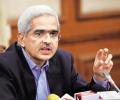
Softening inflation, Das said would make available more policy space to the central bank to address risks to the growth going forward.

India's GDP estimates for 2020-21 show that the economy is expected to perform much better than earlier projections by different agencies, indicating a sustained V-shape post-lockdown recovery, experts said. The first Advance Estimates (AE) by the National Statistics Office (NSO) has projected a contraction of 7.7 per cent in the real GDP during 2020-21. This was better than the projections by certain international agencies like the IMF and World Bank.

New Delhi says existing food stocks will be sufficient to contain any food price shock.

Savings in deposits by the households rose, however, to Rs 1 trillion (17 per cent) in the year to Rs 6.91 trillion in FY14 as against Rs 5.91 trillion in 2012-13.
.jpg)
During April-February, the index of industrial production, a measure of factory activity, declined 0.1 per cent compared with a 0.9 per cent growth in the corresponding period of 2012-13.

India's industrial production contracted by 3.6 per cent in February, official data showed on Monday. According to the Index of Industrial Production (IIP) data released by the National Statistical Office (NSO), manufacturing sector output declined by 3.7 per cent in February 2021. Retail inflation rose to 5.52 per cent in March, mainly on account of higher food prices, government data showed on Monday. The consumer price index (CPI) based retail inflation stood at 5.03 per cent in February.
The wholesale price-based inflation accelerated to a record high of 12.94 per cent in May, on rising prices of crude oil and manufactured goods. Low base effect also contributed to the spike in WPI inflation in May 2021. In May 2020, WPI inflation was at (-) 3.37 per cent. This is the fifth straight month of uptick seen in the wholesale price index (WPI)-based inflation. In April, 2021, WPI inflation hit double digit at 10.49 per cent. "The annual rate of inflation, based on monthly WPI, was 12.94 per cent for the month of May, 2021 (over May, 2020) as compared to (-) 3.37 per cent in May 2020.

The GDP always has a base year, which defines the composition of the economy in that year. As the composition changes, the base year needs to be revised regularly. Abhishek Waghmare explains how that is done.

Improved performance of manufacturing, services and trade sectors helped boost GDP

Foreign portfolio investors (FPIs) remained net buyers to the tune of Rs 12,266 crore in the Indian market in the first five trading sessions of February, as positive sentiment post-Union Budget 2021 sparked a rally in investment.

Under the Commission proposal, Greece would get the whole 7 billion in one go

The previous high in quarterly GDP growth was recorded in the January-March quarter of 2015-16 at 9.3 per cent.

The government on Monday appointed three eminent economists Ashima Goyal, Jayanth R Varma and Shankanka Bhide as members of the rate-setting Monetary Policy Committee of the RBI

If you looked back at 2018 and had to give it a name, the Year of Limitations might be the most accurate.
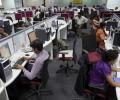
However, the government has enacted an important change to the fixed-term employment framework that may help companies in handing out contractual jobs to its existing permanent workforce.

Nearly 3.64 lakh educated and "semi-educated" youngsters had registered with employment exchanges across Gujarat till December 2021, according to state government data.

'Everyone confuses GDP to be a measure of output, when it is actually a measure of income.'

'They forget that denial of basic rights has helped create a big political void which is adding to a deepening alienation.' 'This creates a fertile ground for extremist elements and targeted killings which we are witness to once again.'

Agriculture, which accounts for 14% of GDP grew at 3.2% in the quarter

The previous high GDP growth of 8.1 per cent was recorded in April-June quarter of 2016-17.

Against a turbulent and uncertain background, Budget 2017-18 hewed a steady, forward-looking course, says Shankar Acharya, former chief economic adviser to the government.

Manufacturing sector grows at 3.5%; agriculture sector at 3.8%
Headed by Urjit Patel, MPC for the fourth straight time kept the repo rate unchanged, at which it lends to the banks, at 6.25 per cent. The reverse repo, at which RBI borrows, will be 6 per cent.

Risk aversion is currently a dominant depressant to economic recovery, points out Shankar Acharya, former chief economic advisor to the Government of India.

Beside manufacturing, deceleration was also witnessed in sectors like agriculture, construction and electricity, gas and water supply.

RE of GDP for 2015-16 show that the economy grew 7.9% in 2015-16, rather than the earlier estimate of 7.6 per cent.

There is lack of scientific basis in computing the poverty line, says govt.
Expect a more modest out-turn of around 5 per cent (if not less) because of the longer-term scarring effects of the Covid shock, the sharply slowing growth in the pre-Covid years and some scepticism about the growth-efficacy of some of recent official policy initiatives, explains Shankar Acharya, former chief economic advisor to the government.

FY17 GDP growth faces cash crunch heat

'We are looking at the Budget with the hope that it will address all issues even at the cost of exceeding the fiscal deficit target.'

There appears to be a growing perception among the political class that faster growth will not create jobs fast enough and, therefore, welfare spending needs to be drastically increased, says T T Ram Mohan.

If imputed inflation for April and May is used, then you have inflation of over 6 per cent for two consecutive quarters, which is a worrying signal for the RBI.
